


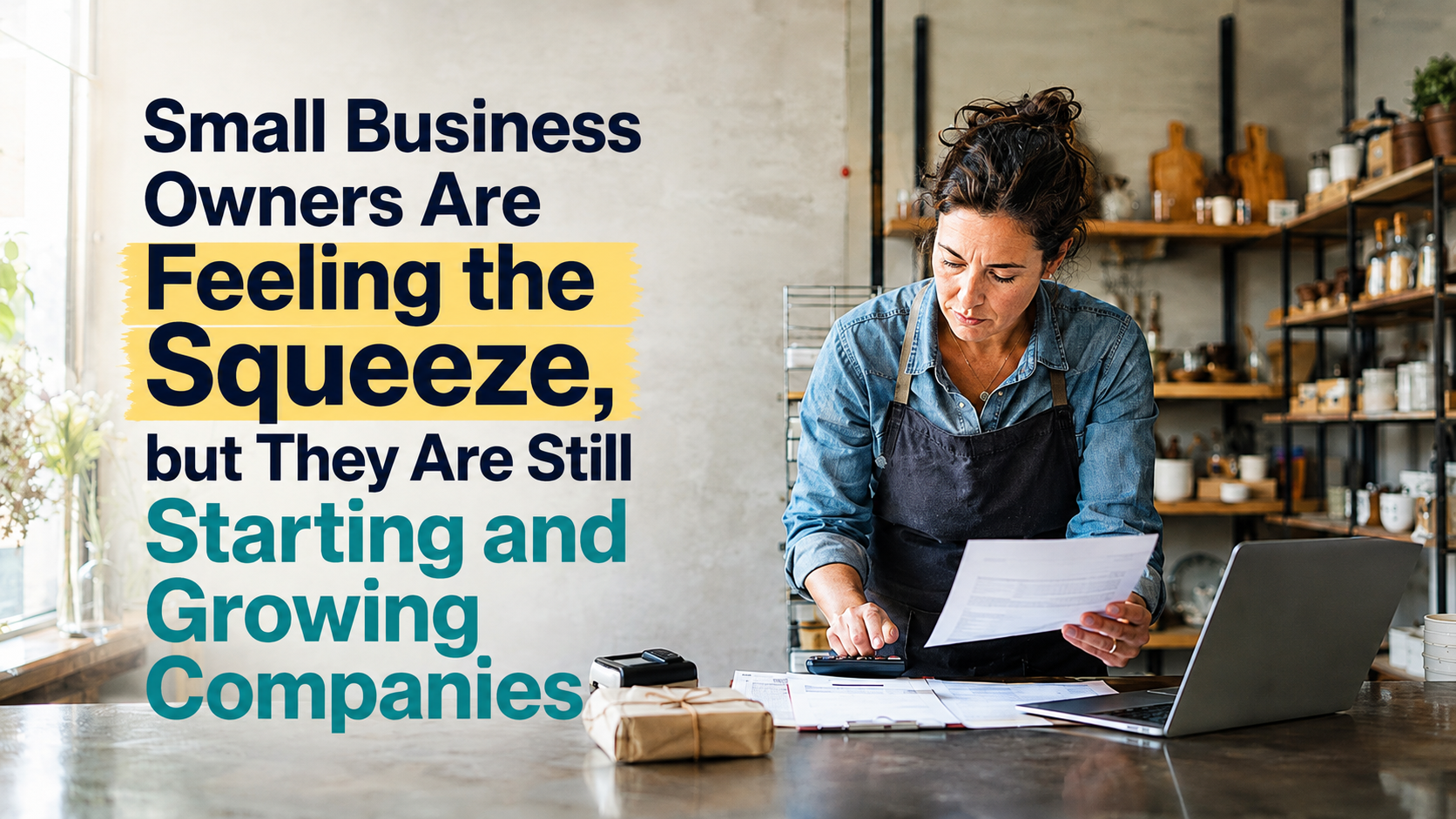
The latest numbers reveal a surprising 2026 trend: higher costs and stronger entrepreneurial confidence are happening at the same time.
Small business in 2026 has a strange vibe.
Owners are worried about costs. Tariffs are showing up in business conversations. Customers are watching prices. Uncertainty is high.
And yet people are still starting companies, existing owners remain surprisingly optimistic and many businesses are actively adjusting instead of backing away.
That combination is becoming one of the year’s most interesting business trends.
Call it cautious resilience.
It is the idea that entrepreneurs can be stressed about the economy and confident about their own businesses at exactly the same time.
The 77% Number Shows How Widespread the Pressure Is
The Federal Reserve Banks’ 2026 Report on Employer Firms found that rising costs of goods, services and wages were the most common financial challenge among U.S. small employer firms in its survey.
More than four in ten also reported increased tariff-related costs as a financial challenge.
Combined, 77% reported one or both.
There is a timing detail worth knowing. The survey was conducted in late 2025, so the figure is not a live September 2026 reading. It does show that many small firms entered this year already dealing with a significant cost problem.
For companies that used foreign inputs and saw those prices rise, the response was very practical.
Seventy-six percent passed at least some higher costs to customers. Sixty percent absorbed at least some themselves.
Only a much smaller group changed suppliers.
That means the tariff and cost story is showing up in everyday business decisions, not just trade headlines.
Customers Are Feeling It Too
Small businesses cannot raise prices in a vacuum.
SoFi surveyed 1,000 U.S. microbusiness owners in February 2026 and found almost 40% felt very positive about their businesses’ future.
At the same time, the survey showed owners dealing with rising costs and more price-conscious customers. Twenty-six percent said customers had become more price sensitive.
So what did owners do?
They changed things.
Sixty-eight percent said they had made quick changes during the prior year. Forty-six percent adjusted prices. Thirty-three percent changed their hours or availability. Thirty-two percent reduced expenses.
Others changed marketing, services and the kinds of customers they pursued.
That is the part of the resilience trend that is easy to miss. It is not just positive thinking. It is constant tweaking.
Canada Is Seeing the Same Push and Pull
The Canadian numbers tell a similar story.
Statistics Canada reported August 31 that 59.8% of businesses expect cost-related obstacles over the next three months.
Inflation was the most common expected obstacle, cited by 41.6%.
At the same time, 72.6% of Canadian businesses said they were very or somewhat optimistic about the next 12 months.
That is a huge gap in mood between the short-term operating problem and the longer-term business outlook.
Trade is part of the story too.
Nearly one in three Canadian businesses expect U.S. tariffs on imports from Canada to have a negative impact over the next year. Manufacturing businesses are much more exposed, with 49.7% expecting a negative effect.
For Canadian small businesses, the impact can appear in several ways. A company might export directly to the United States, rely on U.S. suppliers or sell to another Canadian business that is exposed to cross-border trade.
One policy change can travel through multiple companies before it reaches the final customer.
Owners Are Optimistic and Uncertain at the Same Time
If you want one pair of numbers that sums up the moment, look at NFIB’s July U.S. data.
Its Small Business Optimism Index rose to 99.8, above the long-term average.
Its Uncertainty Index also rose to 91, far above its historical average.
That basically says owners feel good about their businesses and uneasy about the environment.
Canada shows a similar split.
CFIB’s August long-term Business Barometer index was 57.6, above 50. Its short-term index was lower at 52.4.
The trend is not “business owners think everything is fine.”
It is “business owners still think there is opportunity, but they are becoming careful about how they chase it.”
New Business Applications Are Still Coming Fast
This is where the story gets even more surprising.
The U.S. Census Bureau recorded 578,926 seasonally adjusted business applications in July 2026.
That was up 8.1% from June.
Important caveat: a business application is not a guaranteed startup. The Census Bureau separately estimates how many applications are likely to become employer businesses. For the July cohort, it projected 29,959 formations within four quarters.
Still, more than half a million applications in a month is a strong sign that people have not stopped trying to build companies.
Higher costs may be changing the way they start, though.
New founders can launch leaner, use contractors before hiring full teams, automate routine work, start online before taking retail space and build variable-cost models instead of committing to heavy fixed expenses.
In other words, difficult economics can discourage some entrepreneurs while pushing others toward more flexible business designs.
Why Microbusinesses May Have an Advantage
Small size is usually described as a weakness when costs rise.
There is another side.
A microbusiness can sometimes change faster than a larger company.
It can update a price today. It can stop carrying an unprofitable item next week. It can change hours without a committee. It can try a new supplier or service package with fewer internal approvals.
SoFi’s findings suggest many microbusiness owners are using exactly that flexibility.
That does not mean they are protected from cost shocks. A very small company may have less cash and less purchasing power.
It does mean speed can partially offset scale.
The trend to watch is whether smaller firms keep turning that speed into disciplined decisions rather than constant reaction.
The Next Big Small-Business Skill Is Margin Awareness
Here is the less glamorous part of the story.
Resilience depends on knowing the numbers.
A business can look busy and still be losing margin.
A product can sell well and still become unprofitable after freight and materials increase.
A customer can be loyal and still cost too much to serve under an old contract.
The Bank of Canada’s second-quarter Business Outlook Survey shows why this matters. Firms reported higher input costs, while many said they could not fully pass increases to customers because of competition, weak demand or fixed pricing arrangements.
That is where businesses can get squeezed quietly.
The owner who notices early has options.
The owner who notices after cash runs short has fewer.
Cautious Resilience Is More Than a Catchphrase
So what does this trend actually mean?
It means a lot of small businesses are not waiting for the economy to feel comfortable.
They are raising some prices, absorbing some costs, cutting some expenses, changing suppliers when possible and delaying certain investments while moving ahead with others.
They are cautious because the pressure is real.
They are resilient because they keep adapting.
The biggest takeaway for Canadian and U.S. owners is that confidence and caution are no longer opposites.
A business can believe in growth and still keep extra cash.
It can hire for a critical role while delaying a nice-to-have position.
It can raise prices on one service and hold them on another.
It can stay optimistic about the next year while being extremely careful about the next quarter.
That may be the small-business mindset of 2026.
The squeeze is real. So is the entrepreneurial energy.
The trend to watch now is which businesses turn that energy into sustainable growth rather than simply working harder to stand still.
Source transparency: Data and source references used in this article include the Federal Reserve Banks’ 2026 Report on Employer Firms, Statistics Canada’s Canadian Survey on Business Conditions for the third quarter of 2026 and its second-quarter small-business analysis, the U.S. Census Bureau’s July 2026 Business Formation Statistics, NFIB’s July 2026 Small Business Economic Trends results, CFIB’s August 2026 Business Barometer, the Bank of Canada’s second-quarter 2026 Business Outlook Survey, and SoFi’s March 2026 microbusiness survey.








Comments are closed