


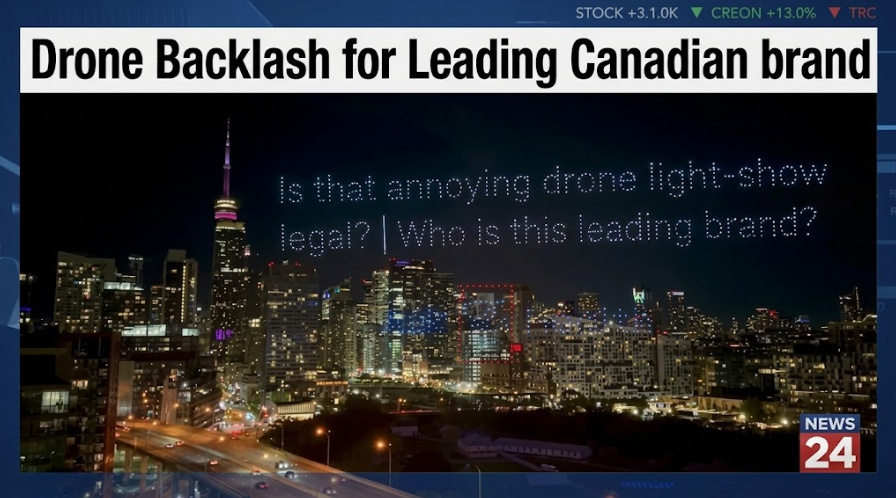
Toronto looked up on September 10 and saw something that was very hard to scroll past.
More than 1,000 drones lit up the waterfront near Fort York with health-related questions before forming a QR code for PC Chat, a new AI-powered health information service from PC Health.
The display started around 11 p.m. and lasted about 15 minutes, according to CBC. It was built for attention, and it got plenty of it.
Then the reaction became the story.
Some residents called the campaign intrusive and dystopian. Social media users questioned whether the night sky should become another advertising surface. One commenter raised concern about distraction for drivers near the Gardiner Expressway.
Suddenly, the launch was not just about AI health information. It was also about drone advertising, public space and where brands should draw the line.
That is why marketers are watching.
First, What Actually Happened?
PC Health launched PC Chat on September 10 as a free AI-powered health information tool built for Canadians.
Loblaw says the service is based on Canadian clinical guidelines and informed by more than 1,000 Canadian clinical sources. PC Health says health conversations are stored in Canada, and users can connect health information for more personalized responses. The tool can also help direct users toward pharmacists and other care options.
The launch campaign was called “Ask Away.”
The late-night drone concept tied directly to the idea that people often have health questions when they are awake at night. The drones displayed questions about topics including sleep and insomnia before revealing the QR code.
From a creative perspective, the connection was easy to understand.
From a public-reaction perspective, things got more complicated.
Yes, the Drone Show Was Permitted
The backlash might make the campaign sound like an unauthorized stunt.
It was not.
The City of Toronto said it had permitted a drone light-show activation above Fort York National Historic Site. Loblaw said it had obtained the required permits. Transport Canada also confirmed to CBC that it issued a Special Flight Operations Certificate for the campaign.
That means the controversy is not simply about whether the company followed the rules.
It is about whether people want this type of advertising in the first place.
That is a much bigger trend question.
The Sky Is Becoming Media
Brands are constantly looking for ways to escape crowded digital channels.
Your social feed is full. Search results are competitive. Streaming services are packed with ads. Influencer marketing is everywhere. Even retail media is becoming more saturated.
So marketers are experimenting with physical spectacle.
Drone shows are part of that movement.
They can turn a launch into an event, create content for social media and make a brand visible from a large area. Unlike a billboard, the display can move and transform. Unlike a normal video ad, people nearby cannot simply hit skip.
That last feature is both the selling point and the problem.
The more impossible an ad is to ignore, the more likely people are to debate whether they should have to see it.
Toronto just gave the industry a very public example.
Why the Word “Dystopian” Keeps Appearing
When people call a marketing campaign dystopian, they are usually reacting to more than the creative itself.
They are reacting to a feeling that commercial technology is entering a space that used to feel outside advertising.
That is what makes drone advertising different from another digital screen.
People expect ads on websites and television. They expect signs on buildings and transit shelters. They do not necessarily expect to look up at the night sky and see a QR code.
The surprise is what makes the experience shareable.
It is also what can make it feel invasive.
That tension is likely to become more common as brands experiment with augmented reality, projection mapping, interactive billboards, location-based messaging and other formats that blur the line between advertising and the physical environment.
The PC Health Angle Makes It Even More Interesting
If this had been a movie promotion or a concert teaser, the reaction might have landed differently.
PC Chat is a health product.
Health information, AI and personal data all involve trust. People want to know whether answers are reliable, what happens to their information and when they should speak to a real healthcare professional.
PC Health’s own messaging emphasizes Canadian clinical guidelines, Canadian data storage and links to care.
That creates an interesting contrast with a marketing format that some residents experienced as intrusive.
It does not mean the campaign hurt the product. There is no public data yet showing whether the controversy increased or reduced usage.
But it does show how quickly the medium can become part of the message.
Drone Ads Are Not as Simple as Hiring a Creative Vendor
There is another reason brands are paying attention: the operational side is serious.
Transport Canada treats certain drone activities as special operations. Flying more than five drones within visual line of sight can fall into a medium-complexity category, and drone shows can require a Special Flight Operations Certificate.
In this case, Transport Canada confirmed that an SFOC was issued.
In the United States, the Federal Aviation Administration has a different set of rules under Part 107. Operating multiple small drones with one remote pilot can require a waiver, depending on the operation.
So any brand thinking about copying the idea needs more than a cool storyboard.
It needs experienced operators, approvals, insurance, safety planning and a location strategy.
What Smaller Brands Should Take From the Trend
Most small businesses are not about to launch a drone swarm.
The important trend is not drones. It is harder-to-ignore advertising.
Technology is giving brands more ways to enter people’s daily environments. That can be exciting, especially for businesses trying to stand out from endless digital content.
But the Toronto reaction shows that attention has a threshold.
A campaign can move from surprising to annoying very quickly.
For smaller companies, the safer lesson is to focus on whether the experience adds something for the audience.
Does it entertain? Is it useful? Does it fit the place? Does it feel welcome? Would people choose to photograph or share it because they enjoyed it, not just because they cannot believe a brand did it?
Those questions matter more than whether the technology looks futuristic.
The Next Viral Ad Could Face the Same Debate
Drone shows are becoming more accessible, and they are visually perfect for social media. It is easy to see why more brands will experiment with them.
That means the debate is probably not over.
Cities may face more questions about where commercial drone displays should be allowed. Residents may push for limits around time, location or frequency. Brands may become more cautious about using shared environments as advertising space.
Or audiences may simply get used to the format, turning today’s controversy into tomorrow’s normal media channel.
That is what makes this story worth watching.
PC Health’s campaign showed both the promise and the problem in one 15-minute display.
The drones made the brand impossible to ignore.
The backlash made the advertising industry think about whether “impossible to ignore” is always something a brand should want.





Comments are closed